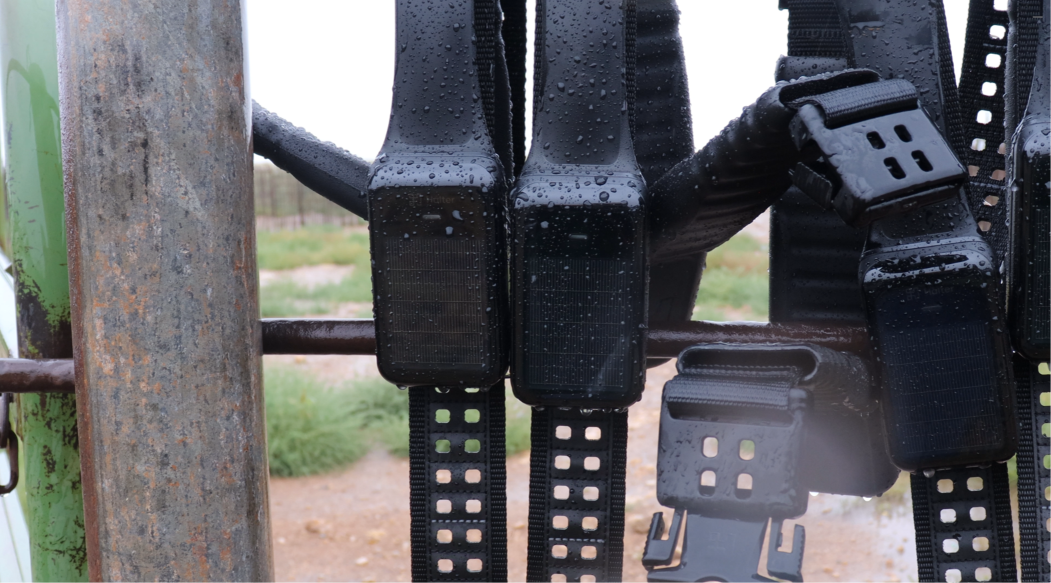
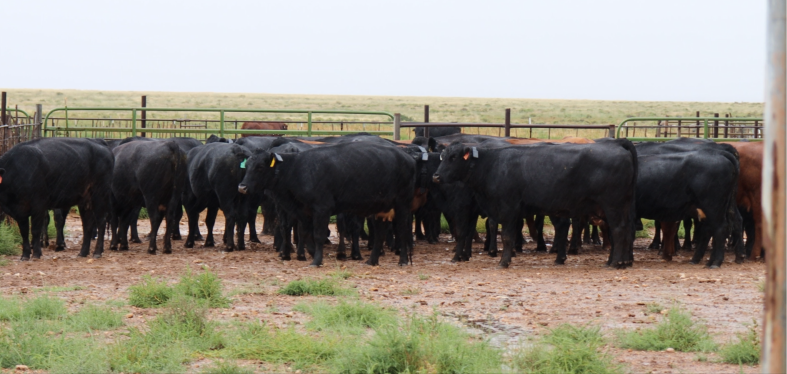
This fall, Bar T Bar took a huge step in adaptive management by collaring their cattle with Halter virtual fence technology. It was a group effort from Bar T Bar, Diablo Trust, UA Cooperative Extension, among others, and it all came together on October 28 with the collaring of 305 cattle.
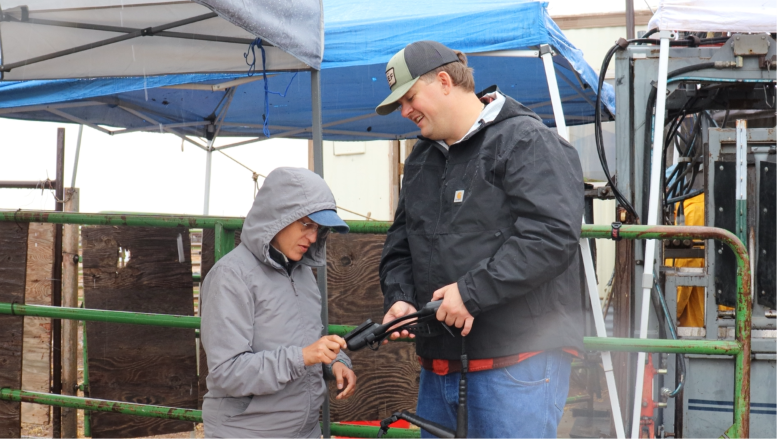
Over breakfast, the Halter team walked us through the app itself, a platform similar to onX or ArcGIS Field Maps. They showed us how to draw “breaks” to set up pastures on the map and assign collar IDs to named “herds.” The learning curve was short. Devin and Kristen Hovey were drawing breaks before the Halter team had even finished describing the process.
The collars use three kinds of cues: an auditory beep, a buzz (similar to a cell phone vibration), and an electrical pulse of varying intensity. The buzz is meant to get the same reaction as an open gate: it tells a cow it’s time to move forward. The beep tells a cow which direction to go, especially when approaching a fence boundary. A beep in the right ear tells the animal to turn left, and a beep in the left ear tells it to turn right, similar to how cattle respond to physical herding. The electrical pulse is reinforcement for when an animal isn’t listening, and it’s used most often during training while animals learn how the system works. These cues work together when it’s time to move the animals.
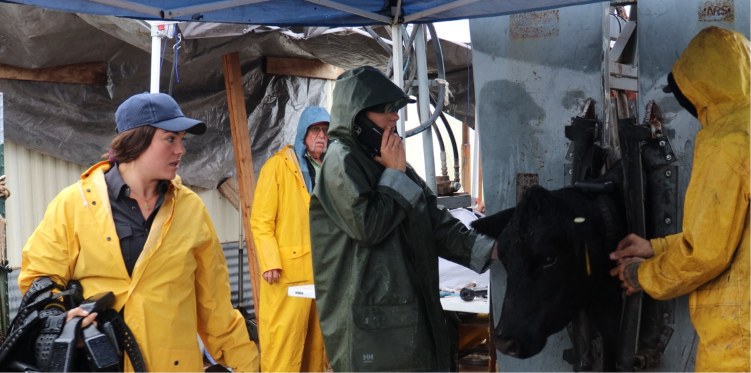
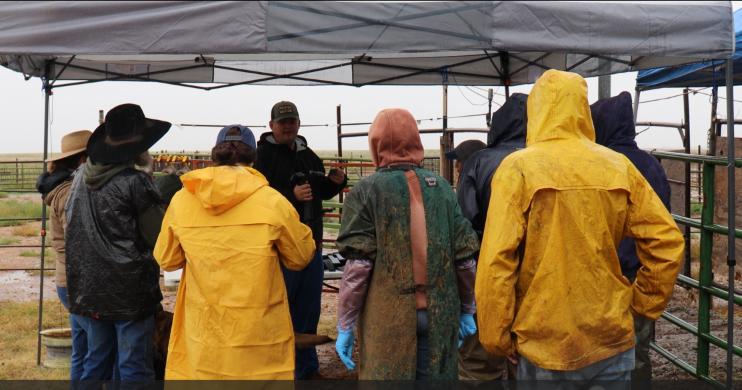
After talking through how it all works and the game plan, we headed outside into the rain. We brought the cattle into the chute, where we checked them for pregnancy, vaccinated them, and collared them. Just like the preparation, this was a team effort. Two people fit collars, others moved cattle along the chute, others scanned each collar ID to assign it to an individual cow, and still others helped with pregnancy checks. The Halter team remarked that Bar T Bar’s curved chute, low voices, and gentle handling kept the cattle calm and easy to work with. The first few hours were slow while we found our rhythm, but by the second day it was a well-oiled machine, to the point that some of us were standing around with no apparent job. While we were there, we talked with Flavie Audoin and Amy Ganguli of the UA Cooperative Extension about the potential they see for this technology in northern Arizona. Their thoughts fell into three broad categories:
Management efficiency: Less time spent looking for cattle frees up rancher capacity for other work, and fewer physical fences to change pastures allow for more flexible management.
Information tool: Collars collect data on individual animals. This opens up research applications, and it could also be an important tool for early detection of threats, such as alerting you if an animal is stuck or behaving erratically. The UA is exploring its use as an early warning system for New World Screwworm, one example of how it could help detect sick animals.
Reducing public conflict: A less discussed benefit of virtual fences is their potential to reduce conflict between the public and ranchers. Because ranchers know where their cattle are at any moment, an open gate or broken fence is less likely to cause conflict; the rancher can quickly collect any strays. The technology can also help ranchers whose cattle are wrongly reported as being somewhere they shouldn’t be, since they’ll have proof of their animals’ whereabouts.
While this technology could be transformative in all these ways, it’s important to note that none of these changes involve replacing people on the ranch. As we sat around the table discussing possible applications, it was put simply: this is a tool, not a replacement for a person. It isn’t just a way to do the same work with less effort. It’s a way to do more creative management without running out of hours in the day. We’re just scratching the surface of what this could make possible, and it’s an exciting time to be involved. If you're interested in virtual fence for your operation, or just curious, here’s some of what we learned from hands-on experience.
Program Use
Can I set up pastures on my laptop?
No. For now, the Halter app only has full functionality on phones and tablets.
For an area of overutilization, can I draw an exclusion zone?
Yes, with some caveats. You can cut out a corner of a pasture, but you can’t draw an exclusion “island” surrounded by pasture on all sides. For now, the map treats the island as part of the allowed pasture, since it falls within one larger continuous area. Halter is working on a solution, but you can often get the result you want by getting creative with geometry and working with existing physical barriers on the landscape.
Moving Cattle
How do the cues work together to move cattle into an adjacent pasture?
When you’re moving animals into a neighboring pasture, cattle facing the right direction get the “move forward” buzz. Once they’re moving, auditory cues help keep them headed the right way. When most of the cattle are in the new area, the virtual border becomes a one-way street: more cattle can move in, but those already in the new pasture can’t move back out. This is called “back-fencing.”
What do I need to move cattle a long distance?
It depends on how much time you have. If you’re not in a rush, you can move them remotely with gradual back-fencing along a corridor, especially if you’re moving them toward water. If you’re short on time, you can still use a virtual chute to set boundaries while herding them physically. Moving cattle this way with dogs can be tricky, since dogs may push cattle outside the virtual corridor without realizing it.
Can I use the collars to recover an escaped cow?
You can’t draw breaks outside the area loaded in your app, so you won’t be able to use virtual fencing to move a cow that has escaped onto someone else’s property. You will, however, be able to see where it is.
How fast do changes in the app reach the collars?
About 12 minutes. It would confuse cattle if only some collars got a change, so there’s a built-in delay that lets every change reach all collars at the same time. This applies both when you move to the next pasture and when you “pause herd” (turning off all rules), so allow 12 minutes for any change to take effect.
Collaring
Which animals should I collar?
Animals younger than 8 months shouldn’t be collared, since they’re still growing and may not learn as readily. Bulls aren’t recommended due to their size and behavior.
What happens if I collar a growing animal?
Collar fit has to be checked and readjusted regularly, so this isn’t recommended if you won’t be gathering your cattle for several months. If you must, it’s better to err on the side of a loose collar than risk choking the animal.
After Collaring
What happens after the cattle are collared?
The step we didn’t stay to see is perhaps the most important. After collaring, cattle need to be trained to associate the cues with the presence or absence of a physical fence. Ideally, animals should be trained in a small pasture where they’ll run into the virtual boundaries often, with those boundaries set close to the actual fenceline. This training period can determine how effective the collars are.